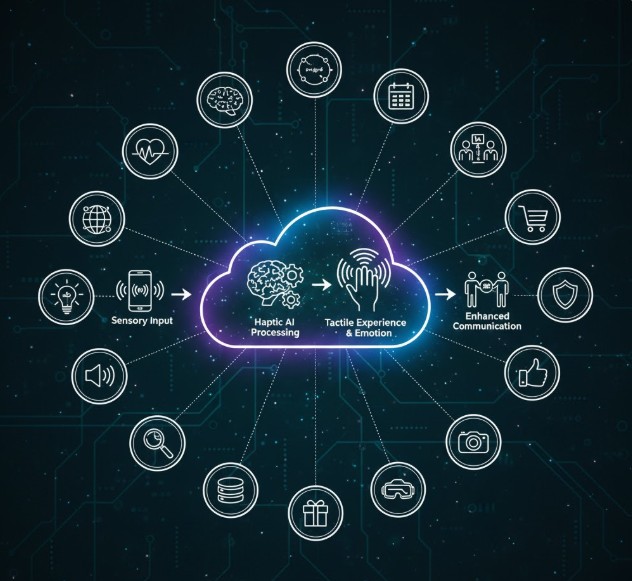
The Future of Haptic Messaging Technology is becoming a major topic as digital communication moves beyond text, audio, and video. Haptic messaging introduces a new layer of interaction by allowing users to feel taps, pulses, vibrations, or pressure patterns sent through devices. Because of this, messaging is shifting toward more emotional and immersive experiences that imitate real-world sensations.

Understanding the Evolution of Haptic Messaging
Haptic features have existed for years, but the next generation aims to create richer, more expressive communication. Instead of simple vibrations, new technologies will produce detailed patterns, force feedback, and textured sensations. As a result, developers can build messaging experiences that feel more human and meaningful.
Why Haptic Messaging Will Transform Digital Communication
1. More Emotional Expression
Touch can convey emotions faster than words. Consequently, haptic messaging enables users to send signals such as comfort, urgency, or excitement through tactile feedback.
2. More Accessible Communication
For users with visual or hearing impairments, haptic patterns offer an additional communication channel. Therefore, haptic interfaces support inclusivity and improve usability.
3. Deeper Immersion in Messaging Apps
Haptic cues enhance presence and realism. Instead of receiving a normal notification, a user might feel a specific pulse pattern representing a friend or priority message.
4. Integration With Wearables
Smart rings, watches, and wristbands will play a crucial role. As haptic components become smaller and more precise, wearables will deliver highly customizable patterns.
Examples of Future Haptic Messaging Use Cases
Real-Time Emotional Signals
A soft pulse could express “I’m here.”
A rapid pattern could indicate “urgent.”
Guided Navigation Through Touch
Haptic directions can help users move through apps or interfaces without looking at the screen.
Communication for VR and AR
Virtual environments feel more real when paired with tactile sensations that match the visuals.
Technologies Driving Next-Gen Haptics
Micro-actuators
Smaller components allow more refined sensations.
Electrostatic haptics
Used to simulate texture on flat screens.
Ultrasonic haptics
Lets users feel shapes or waves in mid-air without touching the device.
AI-driven personalization
Artificial intelligence will adapt haptic patterns to user behavior.
Challenges in Building Advanced Haptic Messaging
While the possibilities are exciting, there are challenges:
-
Creating realistic sensations requires high hardware precision.
-
Power consumption must remain low on mobile devices.
-
Standardized haptic “languages” do not exist yet.
-
Developers must ensure accessibility without overwhelming users.
What the Future Holds
Haptic messaging will continue evolving alongside AI, wearables, and spatial computing. As these technologies blend together, tactile communication will become a natural part of everyday digital interaction. Ultimately, we will move closer to messaging that feels alive—communication you can literally feel.


