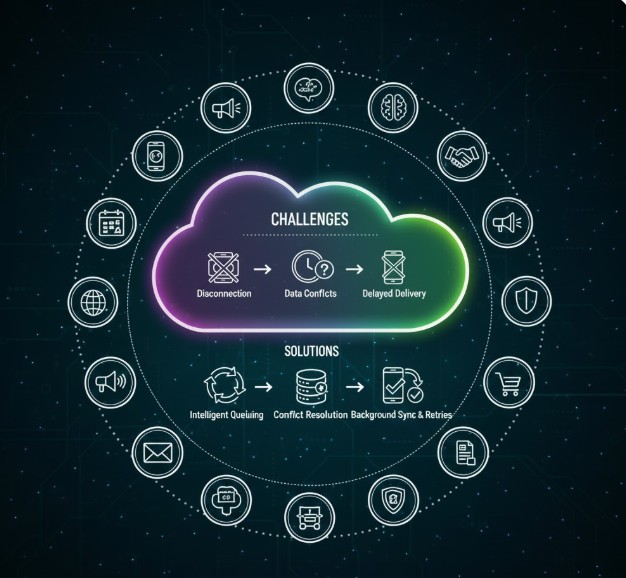
In today’s always-connected world, users still frequently move between high-speed networks, unstable connections, and complete offline states. This makes Offline Message Sync Challenges and Solutions an essential topic for any messaging platform aiming to deliver a consistent user experience. Understanding how messages behave when a device loses connectivity—and how they are later synchronized—is crucial for designing reliable communication systems.

1. Why Offline Sync Is Complicated
Even though offline messaging sounds simple (“store it and send it later”), there are hidden complexities behind it. Messaging platforms must handle:
-
Messages composed offline
-
Messages received while the user is offline
-
Changes made to existing messages
-
Conflicting updates from multiple devices
All of these need to be resolved smoothly when the device reconnects.
2. Challenge: Handling Message Ordering
One of the biggest offline sync challenges is maintaining the correct message order. When users send multiple messages offline, the timestamps may not accurately reflect their intention or order of creation.
Solution:
Systems use logical clocks or sequence IDs to ensure messages appear in the correct order when synced to the server.
3. Challenge: Preventing Duplicate Messages
Devices sometimes retry sending messages multiple times when connectivity is unstable. Without safeguards, this can create duplicated messages in the conversation.
Solution:
Platforms add unique message IDs and server-side deduplication rules to ensure each message appears only once.
4. Challenge: Detecting Conflicts Across Devices
A user may edit or delete a message on one device while another device remains offline. When the offline device reconnects, both states may conflict.
Solution:
Systems implement conflict-resolution models such as:
-
“Last write wins”
-
Version vectors
-
Merge algorithms based on message intent
This ensures the final message state stays consistent across devices.
5. Challenge: Ensuring Data Integrity
When a device reconnects after being offline for a long period, the volume of unsynced data can be large. Without careful handling, data could be corrupted or lost.
Solution:
Reliable data integrity strategies include:
-
Delta-based synchronization
-
Hash-based verification
-
Checkpointing for large message histories
These reduce sync load and prevent inconsistencies.
6. Challenge: Offline Attachments and Large Files
Sending photos, videos, or documents offline is far harder than sending plain text. If the connection drops mid-upload, the sync must resume gracefully.
Solution:
Chunked uploading and resumable transfer protocols ensure large files can pause and continue without restarting from zero.
7. Challenge: Delivering Messages to the Correct Recipients
If a user sends broadcast messages or group messages offline, the syncing mechanism must ensure they reach all intended recipients once the device reconnects.
Solution:
Server-side fan-out and acknowledgment tracking confirm that each recipient receives the message without redundancy.
8. Challenge: User Experience Consistency
The user interface should not confuse users by showing outdated or partially synced data. Offline states must be clear, intuitive, and predictable.
Solution:
Modern apps display states like:
-
“Sending…”
-
“Waiting for network”
-
“Reconnecting”
-
Visual sync indicators
This transparency reduces user frustration.
9. Building Robust Sync Systems for the Future
The increasing use of multi-device workflows, remote environments, and edge-based communication means offline sync will only become more important. Platforms must invest in:
-
Smarter queueing algorithms
-
Environment-aware sync strategies
-
Predictive caching
-
Hybrid online-offline models
These improvements ensure messages feel instantaneous—even when they aren’t.
Conclusion
Offline Message Sync Challenges and Solutions highlights the hidden engineering complexity behind delivering seamless messaging experiences. Although users expect messages to “just work,” achieving flawless offline synchronization requires advanced algorithms, conflict resolution frameworks, and resilient data handling. By solving these challenges, modern communication systems can stay reliable anywhere, anytime—even with unstable or no connectivity.


